

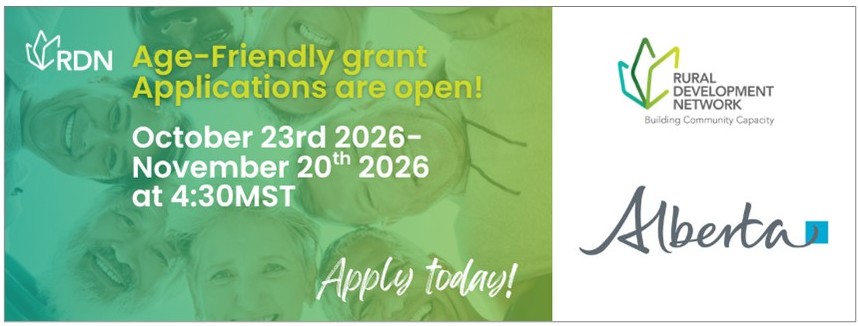
Age-Friendly Community Capacity Building: Empowering communities to support older adults as they age within their community by creating or renewing Age-Friendly action plans.
Age-Friendly Communities were originally established by the World Health Organization and later adopted by the Government of Alberta. These communities work through three key milestones to ensure that their municipality is accessible and supportive of older adults aging within their community. The three milestones are establishing a Committee, doing assessment of local accessibility and support for older adults, and an action plan that directly reflects the needs within your community. Communities have an optional fourth milestone of passing a municipal Age-Friendly resolution; it is not a requirement for this grant but recommended and required for Provincial Age-Friendly Recognition.
There are 8 focus areas with the work for Age-Friendly communities:
This initiative is made possible by the Age-Friendly Grant, with funding provided by the Government of Alberta through the Ministry of Assisted Living and Social Services. The Rural Development Network serves as the primary contact for all grant-related inquiries as well as provides coaching services to those communities that are successful with funding.
Grant application and grant guide are available below; this includes eligibility, application details, and overview of funding guidelines. If you have specific questions regarding this grant opportunity please contact Aleesha Cabay at: Aleeshac@ruraldevelopment.ca.
Please download and save the application and supporting documents to your computer. Once completed, please email the application and all supporting documents to Aleeshac@ruraldevelopment.ca.
| Application Window | Decision on Applications | Project Timeline |
| October 23rd 2026 to November 20, 2026 | January 11, 2027 | February 2027-March 2029 |
Funded by the Government of Alberta

Our dedicated team is committed to supporting rural communities to help them thrive. Connect with us to explore how we can work with you.
Funded through the Public Health Agency of Canada, RDN’s Awareness Builds Connection in Dementia Friendly Communities (ABCD) project was guided by three priorities aligned with Canada’s national dementia strategy, A Dementia Strategy for Canada – Together We Aspire: (1) dementia prevention, (2) reducing stigma related to dementia, and (3) supporting communities to become more dementia-inclusive. The ABCD project worked with five rural Albertan communities, with a larger senior population, interested in adapting an evidence-based, dementia-inclusive initiative into their community. The approach was strengths-based, which allowed selected pilot project leads to oversee their pilot projects as they were the experts on the needs of their community. RDN’s role was to provide seed funding, assist with the planning and communication, and support community consultations as needed.
In February 2022, the Expression of Interest to rural Albertan communities was publicized on RDN’s social media platforms and through outreach to existing partners and networks. In consultation with the ABCD Advisory Committee, five rural communities were announced to have been successful in their applications at the end of March 2022, those communities and associated initiatives being:
ABCD Project Documentary
To learn more about the dementia-inclusive initiatives implemented in Taber, Sturgeon County, Spirit River, Strathmore and Drumheller. please watch the mini-documentary at https://youtu.be/93g5tiyWP4w. Promotion for the documentary is shown below.
Each ABCD pilot community adapted a dementia-inclusive initiative outlined in the ABCD catalogue which included memory cafes, speaker series’, train-the-trainer sessions, and dementia-friendly audit of office and library spaces. Memory Cafes were introduced in three communities, offering safe, stigma-free environments where individuals living with dementia and their caregivers could connect and participate in activities without fear. These cafes also played a role in promoting dementia awareness and reducing stigma within the broader community by involving local organizations and using public spaces.
Efforts to create dementia-inclusive spaces included audits to enhance accessibility in community spaces. Collaborations with local schools and knitting groups produced “twiddle muffs” and activity mats, available for free at local offices. Libraries also contributed by creating dementia-inclusive activity kits and acquiring books focused on dementia, supporting families at various stages of the condition. Educational initiatives included workshops and presentations aimed at raising awareness about dementia among professionals, volunteers, and community members.
In collaboration with the ABCD pilot project leads in each community, five step-by-step guides were developed to support other rural communities in the implementation of dementia-inclusive initiatives.
Age-Friendly, Community Development
Informed by research and the experiences of the ABCD pilot communities, these guides have been developed to support rural communities looking to improve the lives of those living with dementia by becoming more dementia-friendly. Understanding that each community is unique with its strengths and perspectives, this guide is meant to be flexible and adaptable based […]
View
In rural communities, every dollar counts, and every hour matters. Our Shared Services model offers flexible, reliable support across multiple areas, so you can focus on serving your community, not managing administrative overload.
Learn MoreOur tailored sessions cover a spectrum of essential skills and knowledge areas. We can also customize workshops and training to your needs.
Learn MoreOur team works alongside you to successfully address community needs in many areas. We can help with:
Learn MoreOur dedicated team is committed to supporting rural communities to help them thrive. Connect with us to explore how we can work with you.
The Rural Roots program allowed students to gain much-needed experience to transition into their future careers and for employers to boost their capacity while generating projects that have tangible results. Through meaningful engagement in our program, we aimed to raise awareness of the benefits of working, living in, and supporting rural communities.
What is Work-integrated Learning, Rural Roots
Understanding that the landscape of work-integrated learning (WIL) is changing, students or employers have access to a variety of opportunities that suit their needs. From applied research projects to apprenticeships or micro-placements to hackathons, the possibilities are endless.
The core purpose of WIL was to provide value to students (e.g., employability, and personal development) and employers (e.g., access to new talent, new ideas, and the opportunity to grow and diversify their workforce), specifically for those in rural communities.
The Benefits of Rural Roots

The Rural Roots Work Integrated Learning Program created more than 1,000 placements by August 10, 2023. Of these, more than 40% were students from underrepresented communities. The program engaged with 75 businesses that created WIL opportunities and hired post-secondary students. Based on survey results from employers and students, on average 94-95% of participants found WIL to be valuable and beneficial and 100% of students and employers found the resources and support from RDN valuable throughout their experience. Top resources included:
I had the pleasure of working with Rural Roots on another course-based project in Year 1 and saw my ideas being brought to life, so I jumped at an opportunity to take on another project. [This experience] was an opportunity to apply concepts like SWOT analyses and market research to an actual data set. I could see how the data influenced recommendations and supported community development.
Rural Roots Student
Age-Friendly, Community Development
Informed by research and the experiences of the ABCD pilot communities, these guides have been developed to support rural communities looking to improve the lives of those living with dementia by becoming more dementia-friendly. Understanding that each community is unique with its strengths and perspectives, this guide is meant to be flexible and adaptable based […]
ViewNovember 11, 2023
Community Development
Supporting Remote Work-Integrated Learning PlacementsAs remote and blended work becomes the norm, building strong virtual relationships is key, especially when supporting students new to the workplace. Rural Roots offers practical tips and tools to help you adapt, including a job posting template, student onboarding checklist, and project workbook to ensure successful remote placements.
View
In rural communities, every dollar counts, and every hour matters. Our Shared Services model offers flexible, reliable support across multiple areas, so you can focus on serving your community, not managing administrative overload.
Learn MoreOur tailored sessions cover a spectrum of essential skills and knowledge areas. We can also customize workshops and training to your needs.
Learn MoreOur team works alongside you to successfully address community needs in many areas. We can help with:
Learn MoreOur dedicated team is committed to supporting rural communities to help them thrive. Connect with us to explore how we can work with you.


11443-143 Street,
NW Edmonton,
Alberta T5M 1V7


